Large Mausoleum
Pokemon Go: The Ultimate Beginner's Guide For Kindle Book Tips And Trick How to Become The Best Pokemon Trainer: This Kindle Book Will Answer Your Unsolved QuestionsLarge Mausoleum is the dominant structure in the cemetery’s mausoleum section and the decisive setting for the book’s most disturbing episode. Its significance lies in the collision it creates between an ordinary game of collecting Pokémon and a private space associated with death, secrecy, and bodily horror. The narrator approaches it while pursuing a rare Gengar, enters after seeing light at its door, and later returns to find the building completely sealed and inexplicably empty. The structure therefore functions both as a physical location and as the story’s unstable boundary between an experience witnessed and an experience that can no longer be verified.
Setting and Appearance
Large Mausoleum stands among a cluster of burial structures: several small mausoleums, two medium-sized ones, and one notably prominent building. Its scale and visual dominance suggest that the person buried there intended to remain the center of attention even after death. The narrator reaches it after entering a cemetery that has become unusually rich in ghost-type Pokémon and PokéStops, so the building is introduced through the game’s logic as both a landmark and a possible source of rewards.
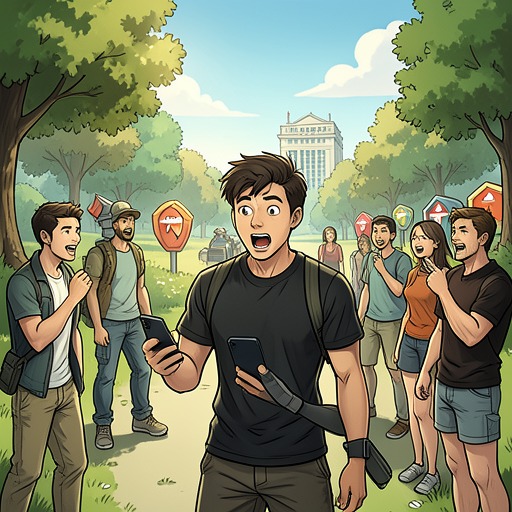
The location’s real-world memorial function is immediately overlaid by Pokémon GO’s system of mapped attractions. In the game, a PokéStop is placed at a real-life monument, changes shape when the player comes close, and can be spun to generate collectible items, with rewards available once every five minutes at each stop. The cemetery and its mausoleums thus become readable as game nodes before they become readable as threatening spaces. Large Mausoleum’s importance grows from that contradiction: it is at once a monument to the dead and a point on an augmented-reality map.
Entry and Descent
The narrator enters the mausoleum after noticing a small beam of light seeping from the door while attempting to catch Gengar near the entrance. That decision marks a deliberate crossing of a threshold. The narrator has a flashlight and a phone, but the precautions associated with parents, horror films, and friends are abandoned in the moment of curiosity. Inside, flaming lights hang from the ceiling, strangely lit despite the apparent abandonment of the place, and the narrator sees the decaying corpses of a man and a woman.
The building then reveals a hidden vertical sequence. Four steps are concealed behind the side containing the husband. Each step changes the narrator’s knowledge of the space. The first brings a blood-curdling scream that sounds familiar; the second produces a silence more frightening than the scream; the third exposes a large concrete room; and the fourth brings the narrator fully into view of the people occupying it. The descent turns architecture into a mechanism for delaying revelation. The mausoleum does not disclose its secret all at once; it forces the narrator downward, one partial discovery at a time.
The Hidden Room
At the bottom is a large concrete room lit in the same manner as the chamber above. Six openings line its sides, each sized for a human body. The narrator speculates that they may originally have been intended for the couple’s children, but their present contents transform the family memorial into something closer to a concealed laboratory. Vials and tubes fill the openings, containing blood, human organs, and various chemicals. The room’s apparent order and equipment make the horror more than a simple encounter with ghosts: it is a space of organized, unexplained human experimentation.
Six masked men surround a table in the room. A naked body is strapped to it, marked by visible injuries, and the scream comes from this figure. The revelation becomes personally terrifying when the narrator recognizes the body as an exact duplicate—or possible double—of the narrator. Its hair, face, body, and even the birthmark on the narrator’s thigh are identical. The mausoleum’s secret consequently shifts from an unknown crime to a threat against identity itself. The room does not merely contain the dead; it contains a version of the living visitor.
Disappearance and Uncertainty
The narrator drops the phone and runs. After escaping through the cemetery, the narrator searches for lost keys and eventually returns to Large Mausoleum, finding no indication of pursuit. The building is completely sealed: there is no crack in the door, no light inside, and no visible people. Unable to reconcile the sealed exterior with what was just witnessed, the narrator smashes through the door in a moment of delirious rage.
Inside, everything that can be checked appears to remain in place. The couple’s corpses and the hidden stairs are still there, and the phone and keys are only a few feet away. Yet the masked men, the duplicate body, the vials, the containers, and the lighting have vanished. The empty room offers no material confirmation of the event. The mausoleum therefore becomes a structure of contradictory evidence: it preserves the architectural traces of the narrator’s route while erasing the scene that gave that route its meaning.
Narrative Significance
Large Mausoleum concentrates the book’s most important tensions. Pokémon GO encourages players to leave the house, explore the city, capture Pokémon, find PokéStops, and conquer Gyms; the narrator initially experiences that invitation as an exciting way to explore a city inhabited for only a few months. At night, however, the same exploratory freedom carries physical danger. The cemetery’s abundance of game activity draws the narrator farther into an unfamiliar and secluded place, while the game’s ghost-type Pokémon make the setting seem narratively appropriate for a haunting.
The location also dramatizes the unstable relationship between augmented reality and physical reality. A digital pursuit leads to a real cemetery, a real monument, and a room that seems to contain an impossible duplicate of the player. The game supplies the initial reason for entering, but it cannot explain what follows. Even the narrator’s later call to the police fails to stabilize the account; the dispatcher is described as doubtful, and friends do not believe the story. The narrator insists on having seen the event, then ends by admitting the possibility that nothing was seen after all. Large Mausoleum remains sealed not only as a building but as an interpretation: its final mystery is whether it concealed an actual experiment, produced a supernatural encounter, or became the physical shape of an experience that cannot be proven.